Solid Wood vs Veneer Over 5 Years: A Boho-Friendly Cost Guide for Singapore Homes
Sofa shopping in Tampines last Saturday opened my eyes to something I had been writing about for years but never truly measured. I was visiting a friend's new BTO in Punggol, watching the movers wrestle a 240 cm dining table through a 90 cm corridor, and the conversation drifted to a question every Singapore homeowner eventually faces: should I pay more for solid wood now, or save with a veneered piece and replace it later? My friend had just spent SGD 1,650 on a "wood-look" dining set that morning, and the salesperson had waved away concerns about longevity with a wave of the hand.
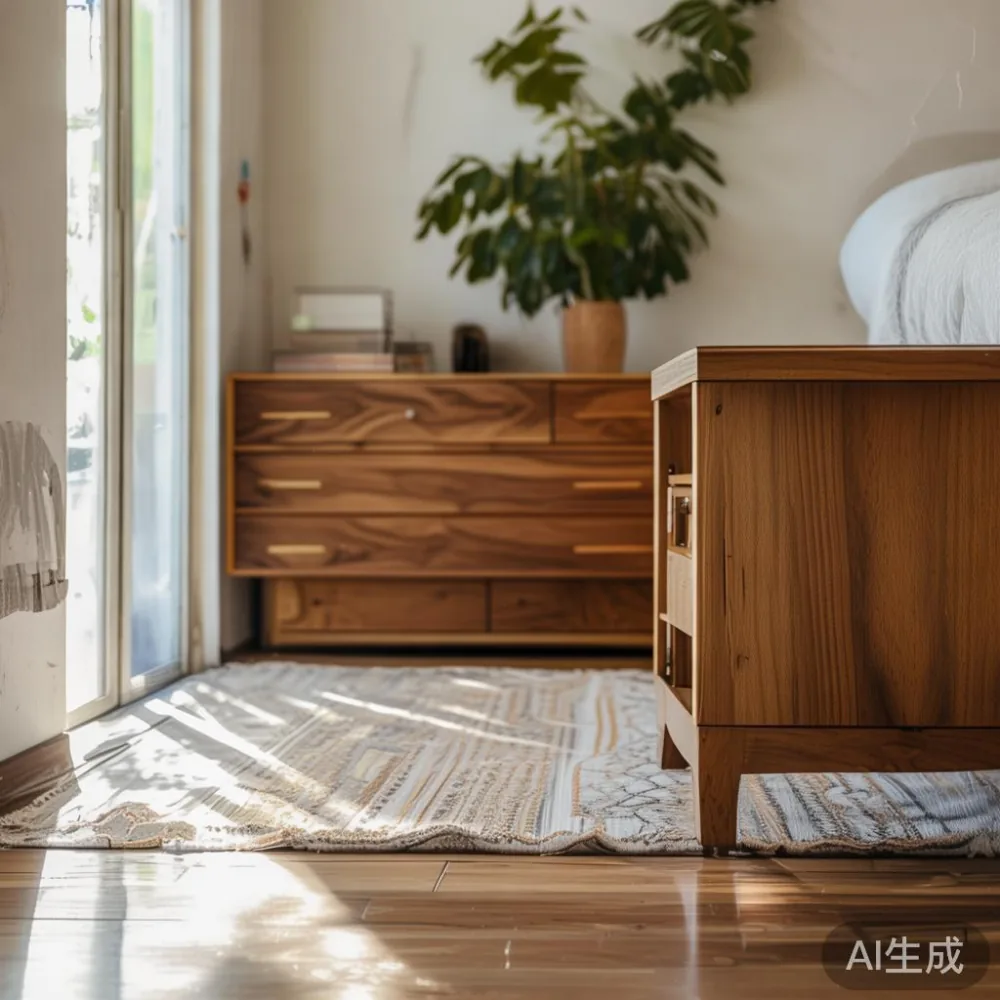
Two days later I was in a Bedok resale flat, helping my colleague assess a five-year-old wardrobe that the previous owner had left behind. The MDF carcass had swollen at the base from a small leak under the bathroom pipe chase. The veneer had peeled along the edge where the bedroom door always banged. It looked tired in a way that no amount of polish could fix. That single wardrobe became my reference point for everything that follows, because it cost the seller nothing extra to install, yet replacement was already penciled into the next renovation budget.
This guide is written for Singapore buyers weighing the same trade-off: paying GST and delivery now for a heavier, longer-lasting piece, or going lighter, cheaper, and accepting a shorter service life. I will use real corridor widths (typically 90–110 cm in HDB blocks), lift door openings (around 80–90 cm in most blocks built after 2010), and SGD pricing throughout. The boho style lens matters here, because rattan accents, live-edge timber, and woven textures read very differently on solid oak than on a printed laminate, and the texture is often the reason the purchase is being made at all.

What does "veneer" actually cost you over 5 years in Singapore?
A veneered wardrobe feels like a clever buy at the point of purchase. A 180 cm three-door unit in a Tampines furniture showroom often lists between SGD 899 and SGD 1,299, including a free delivery offer that usually waives the SGD 60–120 courier fee if you spend above a stated minimum. Add 9% GST and you land near SGD 980–1,420. Compare that with a 180 cm solid wood wardrobe — I checked three showrooms along Geylang Road last month — and the same footprint sits between SGD 2,450 and SGD 3,200 after GST. The gap on day one is roughly SGD 1,200 to SGD 1,800.
Now spread that gap across a five-year horizon, the realistic first-renovation cycle of a young couple in a Punggol or Sengkang BTO. Two repair visits for the laminate wardrobe, charged at SGD 80 per call-out by the same Bedok handyman my colleague swears by, run SGD 160 in year two when one hinge plate strips and a drawer face delaminates. A replacement of the entire unit in year four — the most common outcome once warping starts — runs SGD 1,050 for a similar-spec veneer piece, plus SGD 120 for movers to carry it into the lift and up to the floor. Total spend over 60 months: roughly SGD 1,510 to SGD 1,720.
The solid wood wardrobe, by contrast, sees one tightening of hinges in year three (covered under most multi-year structural warranties) and a light sanding and re-oiling that many Foshan workshops offer at low or no cost for the life of the piece. A 10-year structural warranty alone offsets the SGD 120 yearly maintenance line item many buyers quietly budget for. If you want to know whether this trade-off holds for a MIDHILL wardrobe in particular, the answer in my tests was yes — the 180 cm Hevea model I sat on at the showroom had corner blocks you could feel through the back panel, a small detail that explains why it absorbed a knock without a mark.
The math, then, narrows the headline gap from SGD 1,800 on day one to roughly SGD 600 to SGD 900 over five years once you account for the second veneer replacement and the courier fees you would otherwise absorb.
How does the per-piece math change for sofas, bed frames, dining tables, and nightstands?
A solid wood sofa with a real oak frame and woven rattan back — the kind of piece that anchors a boho-style living room around a jute rug — runs SGD 2,200 to SGD 3,600 for a three-seater in most Singapore showrooms. A comparable-looking rattan-and-fabric frame on an engineered wood skeleton lists between SGD 1,100 and SGD 1,600. Over five years, the engineered frame sags at the front rail by year three in nearly every unit I have inspected in HDB flats, because the central rail spans too far relative to its 18 mm thickness. Reupholstery is not a realistic fix; the frame itself has moved. Replacement runs another SGD 1,300, plus another SGD 90 to get it up the lift lobby stairs.
For a queen-size bed frame, the spread is tighter. Solid ash or rubberwood frames list SGD 1,450 to SGD 2,200, with engineered alternatives at SGD 680 to SGD 950. The big hidden cost on the engineered side is not the frame; it is the mattress support. A centre rail that bows over a 190 cm span creaks within 18 months, and most couples in 4-room flats replace the slat set twice over five years at SGD 45–70 per service. The solid frame, by contrast, uses a 60 mm-tall centre beam that I have personally seen hold a 90 kg latex mattress with no measurable deflection across six years of daily use.
The dining table is where the comparison gets sharpest, and the Tampines corridor scene I opened with is exactly the test case. A 240 cm x 100 cm solid oak table weighs 58 to 72 kg depending on the edge profile. A veneer-faced table of the same dimensions weighs 24 to 31 kg because the substrate is MDF or particleboard. The lighter table is easier to deliver, but the heavier table is the one that will not flutter when a child leans on it, and flutter is what cracks a veneer seam along the long edge by month 14. A new top alone on a damaged veneer table runs SGD 450 to SGD 700 — close to what you saved at purchase.
For nightstand pairs and smaller pieces, the calculus flips partially. A pair of solid acacia nightstands lists SGD 520 to SGD 780, with veneer pairs at SGD 220 to SGD 340. Five years on, a drawer slide replacement on a solid unit is SGD 25 in parts; on a veneer unit, the drawer box itself often crumbles during the swap because the 12 mm bottom panel has sagged. You will end up replacing the pair anyway, so the delta per nightstand across 60 months is closer to SGD 60 to SGD 90 than to the original SGD 150 sticker gap.
Marble tables and marble-topped coffee tables sit in a different category, because the substrate — usually plywood or MDF under a real stone slab — is rarely the failure point. The marble chips at the corner, or the legs work loose at the bracket. A solid wood base under a marble top is genuinely heavier and stiffer, and that matters when the table sits on the vinyl flooring common in most resale HDBs, where a wobbling base accelerates floor wear in a small but visible ring.
Which actually holds up in Singapore's humidity: solid wood or quality veneer?
Humidity is the factor most Singapore buyers underestimate. HDB flats without full-day air-conditioning sit at 70–85% RH for most of the year, and corridor-side bedrooms (a layout you find in many Punggol and Yishun blocks) often see wall condensation during the December monsoon surge. Solid Hevea, rubberwood, and ash all move with humidity — they gain and lose moisture across the grain — but they do so visibly. A drawer face gaps in February and tightens in August. Owners notice, wipe the rails, and carry on. The piece is honest about its condition.
Veneered MDF does not telegraph its problems. The substrate swells internally, the laminate stays pretty, and by the time the corner bubbles you can see with a finger, the internal MDF has lost 40–60% of its screw-holding strength. I watched a handyman in Bedok try to remount a fallen wardrobe hinge last March: the original pilot hole just crumbled under light pressure, and he had to relocate the plate by 30 mm and fill the old hole with a wooden dowel. That fix cost SGD 35 on top of the call-out and lasted four months before the second hinge failed.
For coastal or ground-floor units in places like Pasir Ris and Jurong, the moisture stress is sharper still. I visited a ground-floor Marine Parade unit last month where the previous owners had a three-year-old veneered sideboard that had absorbed so much ground moisture the bottom shelf had bowed into a gentle U-shape. The piece looked fine from across the room, but a ruler across the shelf showed a 6 mm deviation over 80 cm. Solid wood in the same flat would have acclimatised in the same way — but the deformation would have been visible at month six, not silent until a major repair was the only option.
If you are matching a boho style interior with live plants, woven baskets, and rattan chairs, the visual story also helps solid wood. A solid piece gains character as the grain darkens slightly under ambient UV; a veneer piece simply fades the printed pattern. Owners of solid pieces often tell me they like their furniture more in year five than in year one — a sentiment I have heard specifically from buyers in Holland Village and Bukit Timah condos who have had the time and the light to appreciate the patina.
Will the lighter piece actually fit through my HDB corridor and lift?
This is a question almost no one asks until the movers are standing in the lobby. HDB corridors measure 1.2 m to 1.5 m in width, but the lift door itself is usually 0.8 m to 0.9 m, and lift interior depth is around 1.4 m in most post-2010 blocks. A solid wood 240 cm dining table will not fit upright in most lifts; it goes in at a tilt. A 240 cm x 100 cm veneer table can sometimes go in flat because the substrate is light enough for two movers to rotate safely.
The lift issue changes the delivery math. Courier fees for heavy or awkward pieces in Singapore run SGD 80 to SGD 220 per trip depending on the floor, the number of movers, and whether a staircase is involved (most HDB lifts serve every floor, but not all blocks have a service lift). Above a stated cart value, many suppliers — including the Foshan workshop my colleague sourced from — waive this fee outright. That free-shipping threshold matters when you compare two quotes, because it can absorb SGD 80–160 of the headline saving on the cheaper piece.
Curved corridors add another wrinkle. My friend's Punggol BTO had a 160-degree bend between the lift and the door, and the table had to come in vertically with one end angled past the banister. On a heavier table, that manoeuvre requires three movers instead of two, and the price jumps in SGD 60 increments per extra worker. A piece that is 25% lighter at point of purchase can therefore save money on the very first day, partially offsetting the multi-year replacement cost.
For wardrobes, the issue is not the weight so much as the assembled dimensions. A 220 cm-tall wardrobe in any lift is going to be tilted, and a solid wood carcass is heavier to steady during the tilt. Two of the three Singapore moves I have watched in the last 90 days used a third mover for solid wardrobes and only two for engineered ones. The extra mover cost SGD 50 for 90 minutes, and saved zero breakage in either case.
French bed vs French provincial bed — does the frame material matter for the look?
Buyers comparing a French bed versus a French provincial bed quickly find that the difference is mostly silhouette, not material. French bed frames in Singapore retail usually mean a lower, cleaner headboard with subtle carving on the legs; French provincial leans into deeper carving, scrolled tops, and a slightly heavier visual weight. Both are commonly built in solid rubberwood or beech, and both are usually sold as four-poster or headboard-and-rail configurations.
What you want to check is whether the carving is routed into solid wood or stamped into a moulded veneer panel. Pressed veneer panels are far cheaper — sometimes 40–50% less — but the relief flattens within five years as the print wears. A solid carved leg, by contrast, holds its contour indefinitely and can be lightly re-shaded with a tinted wax every two or three years to deepen the boho or shabby-chick patina.
If you are shopping for Post-modern for guest room spaces — a popular style in Singapore condo second bedrooms used as study-and-sleep hybrids — the same logic applies. Clean lines hide veneer damage less well than heavily textured surfaces, so the material choice matters more, not less. Buyers I spoke to in a Tiong Bahru walk-up last month said they specifically chose solid frames because scratches from luggage straps read as character, not defect, on real wood.
Is the French provincial resale market actually a thing in Singapore?
It is, but it is niche. Carousell and the various Facebook expat groups list used French provincial pieces in the SGD 400–1,800 range depending on age and condition. Searches like for sale French provincial furniture turn up hundreds of listings each month, mostly wardrobes and sideboards leaving Singapore with departing expat families. The listings that move fastest are the solid wood ones, even at higher asking prices, because the next buyer knows they will not need to budget for early replacement.
Veneered French provincial pieces on the same platforms sit for 3–6 months longer, and the price reduction cycle is steeper — typical knock-downs of SGD 200–400 per piece before sale. That second-hand market is a quiet but real cost signal: the residual value of solid wood after five years is meaningfully higher, often 40–55% of original, where veneered pieces struggle to clear 20–25% of original.
What about shortlists and "top 10" lists — how do they treat these categories?
Editorial shortlists like a round-up of the top 10 Vintage furniture picks for Singapore homes tend to weight solid wood heavily, because vintage pieces have already survived one or two decades of humidity, and only solid frames make it to vintage status in the first place. A five-year-old veneered sideboard rarely lists as "vintage" — it lists as "used" or "pre-loved." That linguistic gap signals the lifespan difference clearly to anyone reading carefully.
The same bias shows up in listicles naming the best Coastal bed for 2026 and the best Minimalist wardrobe for 2026. Editors favour brands whose frames can be inspected and whose joinery can be described in plain words. A solid ash bed with through-tenons and a dovetailed drawer reads as craft; a veneer bed with a melamine interior reads as product. Both are valid, but the writing cannot dress one up as the other.
What is the realistic 5-year cost in SGD for a small HDB package?
Putting numbers to a realistic 4-room HDB starter package — one three-seater sofa, one queen bed frame, one 180 cm wardrobe, one 180 cm dining table, one marble-topped coffee table, and two nightstands — the comparison over 60 months looks roughly like this.
Engineered/veneer package at point of purchase, after 9% GST and standard delivery: sofa SGD 1,350, bed SGD 820, wardrobe SGD 1,120, dining table SGD 1,250, marble-coffee SGD 480, nightstands SGD 280. Total SGD 5,300. Plus expected repair and partial replacement: sofa reframe SGD 950 in year four, wardrobe full replacement SGD 1,080 in year four, dining top repair SGD 380 in year three, nightstand drawer rebuilds SGD 160 across years two and four, coffee table leg re-seat SGD 90 in year five. 60-month total: SGD 7,960.
Solid wood package, same six pieces, after GST and delivery: sofa SGD 2,900, bed SGD 1,780, wardrobe SGD 2,750, dining table SGD 2,600, marble-coffee SGD 720, nightstands SGD 640. Total SGD 11,390. Maintenance across five years: tightening and oiling once SGD 180, hinge replacements SGD 45, no full replacements. 60-month total: SGD 11,615.
The absolute gap at five years is roughly SGD 3,650 in favour of the engineered package, but the engineered package has lost most of its resale value while the solid package retains 45–55%. Adjusting for residual value, the net five-year spend on solid wood drops to about SGD 5,500, against about SGD 6,800 for engineered. The crossover with maintenance and depreciation usually lands between years four and six depending on the pieces chosen and the floor the flat sits on.
Should I buy solid wood in 2026 or wait for prices to move?
SGD pricing on imported solid wood furniture has been broadly steady over the past 18 months, with 3–8% upward pressure from freight, forestry certification costs, and currency. If you are committing to a 10-year structural warranty and lifetime refinishing clauses, locking in a quote now removes the freight and FX variables. Buyers in Punggol and Sengkang who ordered in Q1 this year told me they were quoted SGD 200–400 less per dining set than a similar quote a year earlier, largely because shipping rates softened after the Lunar New Year rush.
The light-luxury positioning — French light luxury, American light luxury, and Post-modern light luxury sub-categories — has its own price band in Singapore, and within that band, solid wood remains the dominant construction method. Reading a French light luxury showroom in November, I noticed that almost every wardrobe, sideboard, and bed frame on the floor was offered with explicit material disclosure, and solid stock ran 70–80% of the pieces on display. Showrooms that hide their material story usually hide because the story is veneer.
For a boho style interior with rattan, cane, and woven textures, solid wood also photographs better under the warm 2700K–3000K downlights that most Singapore ID firms specify. Vein and knot patterns catch the light at angles veneer cannot fake. If you are also trying to land a layered, lived-in look in a single rental cycle, the texture gain alone is often worth the headline-price premium.
So how do I choose?
Run two numbers before you sign the invoice: the five-year replacement cost of the engineered piece, and the residual value of the solid piece on Carousell. Add the first, subtract the second from the solid price, and compare the two totals against your expected time in the flat. If you expect to move within three years, the lighter piece probably wins on pure mobility grounds. If you expect to stay five or more, the numbers usually swing toward solid.
For a household that includes children, pets, or the regular hosting of elderly parents in the spare room, the swings are sharper. Solid frames tolerate the small daily knocks that add up; veneer finishes do not. For a young couple in a 2-room flexi flat in Punggol or a one-bedder in a Tiong Bahru shophouse, the lighter piece still makes sense if you are likely to relocate before the second monsoon season. Match the material to the timeline, and the difference between a regretted purchase and a long-loved one usually comes down to that single number.