What Actually Drives the Price of Solid Wood Furniture
Last month, while visiting a Tampines HDB flat with my colleague, I watched her press her palm flat against a reclaimed teak dining table she had been eyeing for weeks. The price tag read SGD 2,180. She looked at me and asked the question I now get at least three times a week: "Why is this so much more than the engineered wood one next door at SGD 690?" I sat on the floor, knocked twice on the underside, and we spent the next ninety minutes pulling that price apart, joint by joint.
Most Singapore buyers assume solid wood furniture is marked up because it "looks nice." The real answer is far more interesting, and far more practical once you live with a piece for a decade. Below is the breakdown I walked her through, the same one I use when pricing a boho-style solid wood dining table, a solid wood sofa frame, or a boho-style bed frame for a 95-square-metre Punggol condo.
1. Species, Moisture Content, and Where the Board Actually Came From
The single biggest driver is the wood species. A solid wood dining table in ash runs roughly SGD 1,400–1,900 for a 1.8-metre six-seater. The same table in walnut lands at SGD 2,400–3,200. In Burmese teak, you are looking at SGD 3,600 and up. The gap is not marketing. Walnut and teak are slower-growing, denser (640–720 kg/m³ versus ash at around 670 kg/m³ but with tighter grain), and yield less usable timber per log.
The second factor people miss is moisture content. Kiln-dried to 8–12 % MC, solid wood moves less in Singapore's 28 °C, 80 % humidity environment. Air-dried stock sold by small workshop buckets often arrives at 18–22 % MC, which means a 200 cm bed frame can cup or bow 4–6 mm across the span within six months. Proper kiln schedules add roughly SGD 180–260 to the cost of the raw boards, but they prevent the kind of callbacks that ruin a maker's reputation. MIDHILL, for example, kiln-dries to 10 % MC and stickers every board for 21 days before machining — the kind of step you cannot see on the showroom floor but feel for the next ten years.
2. Joinery: The Hidden Half of the Price
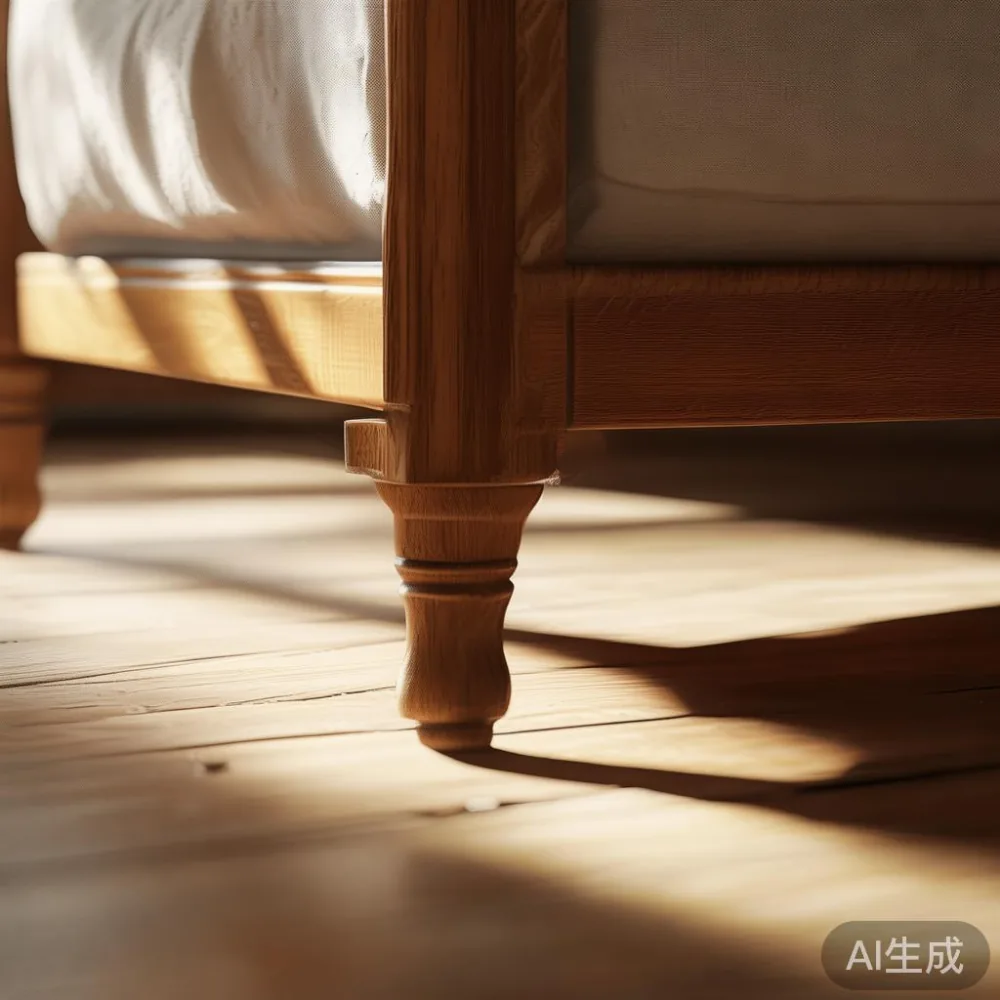
If species is the headline, joinery is the body copy. A boho-style solid wood bed frame joined with dowels and pocket-hole screws can be assembled in 22 minutes by one person. The same frame, with through-tenons, wedged mortise-and-tenon corners, and hand-cut dovetails on the stretchers, takes a cabinetmaker four to six hours. At a Foshan workshop rate of roughly SGD 18–24 per skilled labour hour, that is an extra SGD 320–480 per bed.
For a solid wood wardrobe the maths scales further. A 200 cm × 60 cm × 220 cm three-door wardrobe uses 14 mortise-and-tenon joints, 28 dovetail drawer joints, and 60-plus dowels. Replacing the mortise-and-tenons with cam locks and confirmat screws drops labour by roughly 18 hours, saving maybe SGD 360 — but it also drops the structural warranty from 10 years to roughly 3–5, because cam locks loosen under the cyclic loading that wardrobes see every time you open a drawer.
This is where light-luxury positioning quietly does its work. American light luxury furniture tends to use mortise-and-tenon construction even on pieces that look casual, because the design language depends on the joint staying tight under load. French light luxury leans further, often combining mortise-and-tenons with hidden floating panel construction so the door breathes. Post-modern light luxury blends both, mixing chunky through-tenons with cleaner lines. None of this is visible from a Tampines HDB corridor, but it is what separates a SGD 3,200 wardrobe from a SGD 1,100 one.
How do I choose a care sofa for a condo?
For most Singapore condos, a care sofa — short for corner-care, meaning an L-shape sized to the lift lobby and corridor of a typical HDB block — works best at 220–240 cm long on the long side and 150–160 cm on the return, so it can ride a 1.2 m × 2.1 m goods lift and round a 1.5 m corridor turn. A solid wood sofa frame at those dimensions, kiln-dried and mortise-and-tenon joined, will weigh 55–68 kg and cost roughly SGD 2,400–3,100. Anything lighter usually means HDF or plywood in the frame, which shortens service life to about five to seven years under daily use.
The other condo concern is the lift door. Measure yours before ordering. Standard HDB goods lifts are 1.0 m wide × 2.1 m tall, but newer BTOs in Punggol and Bedok have widened to 1.2 m. A solid wood bed frame in king queen configuration disassembles into four sub-300 mm components that pass either lift, but a fully assembled queen frame at 152 cm × 213 cm will not fit through a 1.0 m opening. A good supplier will publish component dimensions, not just the assembled footprint.
3. Hardware, Finish, and the Things You Touch Every Day
Hardware is where price tags either make sense or fall apart. A boho-style nightstand in solid acacia might cost SGD 480 with steel cup hinges and basic ball-bearing slides, or SGD 620 with soft-close Blumotion hardware rated for 80,000 cycles. The hinge difference is about SGD 28 per nightstand; the perceived quality jump is enormous.
Finish matters just as much. A nitrocellulose lacquer spray finish, three coats, hand-sanded between coats, adds about SGD 140–180 to a dining table and gives the warm satin feel you expect from a boho-style piece. A polyurethane finish, applied by roller in two coats, adds maybe SGD 60 and feels plasticky. Wax-oil finishes, popular in European boho design, sit in the middle at SGD 90–120 extra and age beautifully but need re-oiling every 18–24 months in an HDB without constant air-conditioning.
Then there is the marble table. Real Carrara marble tops on a solid wood base add roughly SGD 480–720 per square foot of marble, because the stone is quarried, cut, sealed, and crated with wooden crates that add 14 kg per top. Engineered marble or sintered stone tops cost 40–60 % less but scratch differently and cannot be refinished. For a 120 cm round coffee table for small apartment layouts, a 3 cm sintered stone top over a solid ash base lands at roughly SGD 1,050–1,350 — a useful sweet spot for Bedok and Punggol three-room flats where you want the marble look without the 85 kg lifting problem during delivery.
4. Logistics, GST, and the Last 50 Kilometres
Singapore buyers often forget that solid wood is heavy. A 1.8 m solid wood dining table weighs 70–95 kg. A solid wood wardrobe can weigh 180–240 kg. Shipping a wardrobe from Foshan to a Singapore warehouse runs SGD 380–520 by sea, plus roughly SGD 90–140 in customs and port handling. GST at 9 % applies on the CIF value, so on a SGD 2,800 wardrobe you add roughly SGD 252 in GST. Free shipping over a purchase threshold — MIDHILL offers it above US$350, which about SGD 480 — absorbs some of this, but the weight surcharge on pieces over 100 kg is real, usually SGD 60–120 per item.
Delivery day matters too. A specialist crew that brings two men, blankets, and a hydraulic tail-lift will charge SGD 80–160 per trip within Singapore. A solo driver with a hand truck will charge SGD 40–60 and will not be insured against HDB corridor scratches. Most buyers I work with in Tampines and Bedok choose the two-man option because the cost is roughly 3–5 % of the furniture value, and it prevents the far more expensive SQM class of problem: a damaged panel discovered after the truck leaves.
5. Warranty, Refinishing, and the Real Cost Over Ten Years
A ten-year structural warranty is not just a marketing line. It implies the maker is paying roughly 0.8–1.2 % of revenue into a repair reserve. On a SGD 2,800 wardrobe, that is SGD 22–34 per year set aside. Makers who offer lifetime refinishing, like MIDHILL, set aside another 1–1.5 % annually to cover sanding, re-oiling, and re-coating costs over the piece's life. Spread over ten years, that adds roughly SGD 280–420 to the price you pay today, but saves you SGD 800–1,200 in refinisher fees if the piece gets a gouge or sun fade.
Think about it the way my colleague eventually did. Her SGD 690 engineered-wood table would last roughly 6–8 years in her Tampines flat before the MDF core swelled from one accidental spill. At SGD 690, amortised over 7 years, that is about SGD 99 per year. Her SGD 2,180 solid wood teak table, amortised over 25 years with one free refinish in year 12, works out to roughly SGD 73 per year. The solid wood piece is not more expensive; it is cheaper per year of use, and it can be sanded back twice and still outlast her lease.
6. Why Boho Style Costs What It Costs
Boho-style furniture lives or dies on its surface character — the knots, the slight unevenness, the visible hand of the maker. That look is genuinely more expensive to produce than a uniform contemporary finish, because each board is selected for its grain rather than its yield. A boho-style solid wood dining table might use 1.4 cubic metres of raw ash to produce 1.0 cubic metre of finished, visible-quality boards. The remaining 0.4 cubic metres, roughly 28 % of the log, becomes offcut and is sold at a discount. That 28 % yield loss adds roughly SGD 180–260 to every cubic metre of visible timber.
The same logic applies to a boho-style nightstand with hand-carved drawer pulls, or a boho-style bed frame with intentionally uneven plank tops. Each hour of hand-finishing adds SGD 18–24 in labour, and a finished piece might carry 4–7 hours of that work. When you see a price that looks high, roughly one-third of it is finishing and selection, not raw material.
7. How to Read a Price Tag Like a Maker
Three quick checks separate a fair price from a fantasy one. First, ask for the moisture content reading. Anything above 12 % MC in Singapore is a red flag. Second, count the joints on a product photo. If a wardrobe has fewer than six visible mortise-and-tenon corners in the marketing render, it almost certainly uses dowels and confirmat screws in the hidden spots. Third, weigh the piece. A solid wood dining table under 45 kg for 1.8 m is engineered, not solid. A solid wood sofa frame under 42 kg is plywood-cored.
Use these three numbers against any quote and you can benchmark within roughly 8–12 % of the maker's true cost. That is how my colleague decided on her teak table, and why she is still happy with it two months in, while two of her neighbours are already returning their cheaper alternatives.
FAQ
Is solid wood worth the premium in HDB humidity? Yes, provided the wood is kiln-dried to 8–12 % MC and finished on all six sides. The thicker the board, the more stable it is — anything below 18 mm thickness will move noticeably across a Singapore monsoon season.
How long does delivery from Foshan to Singapore take? Sea freight from Foshan to Singapore typically runs 8–14 days, plus 2–3 days for customs, port handling, and GST processing, so plan for roughly 14–18 days door-to-door. Air freight is faster at 4–6 days but adds roughly SGD 8–12 per kilogram.
Can a solid wood bed frame be moved up a HDB corridor? Yes, if the supplier ships it flat-pack with components under 300 mm wide. A fully assembled king frame at 183 cm × 213 cm will not pass through a standard 1.0 m goods lift, so always confirm component dimensions before ordering.